
Peptides ExplainedWhat They Are & What the Research ShowsBPC-157, TB-500, CJC-1295, ipamorelin, GHK-Cu and 20 more peptides.
What are peptides?
Peptides are short chains of amino acids, usually 2 to 50 links long, that act as messengers in your body. Each one fits specific receptors on your cells and tells them to do something, like release a hormone, repair tissue or calm inflammation.
Your body already makes thousands of them, including insulin, oxytocin and GLP-1. Peptide therapy uses natural or lab-made peptides to send more targeted signals. The research behind them ranges from approved medicines to early animal studies, and that range is what this guide is about.
- Peptides are smaller than proteins. The usual cutoff is about 50 amino acids.
- They work like keys. Each fits specific receptors and triggers one kind of response.
- Most are injected because digestion breaks them down like food.
- Evidence varies widely. GLP-1 medicines have huge trials. BPC-157 is mostly animal research.
- The right choice depends on your goals, health history and labs, which is why a provider conversation comes first.
A key, a lock and a message.
Peptides are signals. They travel to a cell, fit a receptor on its surface like a key in a lock, and switch on a specific response inside. Pick a peptide to send its signal.
Releases a pulse of growth hormone
Ipamorelin mimics ghrelin at the pituitary, which answers with a natural pulse of your own growth hormone.

- 1
The signal arrives
A peptide is released by a gland or injected under the skin and travels through tissue and blood.
- 2
It finds its receptor
Its shape matches specific receptors, which is why each peptide has a narrow, targeted job.
- 3
The cell responds
The receptor switches on a chain reaction inside the cell: release a hormone, build tissue, burn fuel or calm inflammation.
- 4
The body clears it
Most natural peptides break down within minutes. Lab versions are often modified to last hours or days.
Famous peptides you've heard of
Moves sugar from blood into cells. The first peptide hormone ever used as a medicine, in 1922.
Mimics the gut hormone GLP-1 to signal fullness. The peptide behind today's weight-loss boom.
The bonding hormone. Also used in hospitals to start labor.
Your main cellular antioxidant and a popular IV add-in.
The powder in your coffee. Digested like food, so it works differently from injected peptides.
Peptides vs. steroids, hormones and supplements
| Compare | Peptides | Steroids | Collagen supplements |
|---|---|---|---|
| Made of | Short amino acid chains | Cholesterol-based rings | Digested protein fragments |
| Works by | Fitting receptors on the cell surface | Entering cells and changing gene activity | Supplying building blocks |
| How it's taken | Mostly injection, some nasal or topical | Pills, injections, creams | Powder or pills |
| Targeting | Narrow, one receptor type | Broad, many tissues | Nonspecific |
How are you feeling lately?
Pick what sounds most like you. We'll show which peptides researchers study for it, plus the basics worth checking first. This is for learning, not a diagnosis.
My body heals slowly
Slow recovery, nagging injuries, sore joints
Peptides researchers study for this- Sleep is when most repair hormones peak. Seven to nine hours matters more than any add-on.
- Protein intake and progressive, well-dosed training load.
- Have a clinician rule out injuries that need imaging or physical therapy.
I can't lose stubborn weight
Weight that won't move, belly fat, cravings
Peptides researchers study for this- Know your real metabolism. A resting metabolic rate test measures how many calories you burn.
- Labs for thyroid, insulin and blood sugar.
- Strength training to protect muscle while losing fat.
I'm tired all the time
Low energy, slow mornings, afternoon crashes
Peptides researchers study for this- Start with labs. Iron, B12, vitamin D, thyroid and blood sugar explain a lot of fatigue.
- Sleep quality, not just hours.
- Hydration and steady meals.
My brain feels foggy
Poor focus, stress, mental fatigue
Peptides researchers study for this- Sleep, stress and blood sugar swings are the usual suspects.
- Check medications and alcohol intake.
- Regular aerobic exercise raises BDNF naturally.
I don't sleep well
Trouble falling or staying asleep, waking tired
Peptides researchers study for this- A consistent wake time, a dark cool room and less late caffeine.
- Screen for sleep apnea if you snore or wake gasping.
- Alcohol cuts deep sleep, even in small amounts.
I'm noticing skin and aging changes
Fine lines, slower healing, thinning skin
Peptides researchers study for this- Daily sunscreen is the most proven anti-aging step for skin.
- Protein and vitamin C support collagen.
- Avoid smoking and limit sugar spikes.
- Hormone labs (testosterone, estrogen, thyroid) and a medication review.
- Stress, sleep and relationship factors matter as much as chemistry.
My gut is a mess
Bloating, irritation, sensitive digestion
Peptides researchers study for this- Track trigger foods and fiber intake.
- Persistent symptoms need a medical workup, not just supplements.
I get sick a lot
Frequent colds, slow bounce-back
Peptides researchers study for this- Vitamin D and zinc status, sleep and stress load.
- Make sure vaccines and checkups are current.
The evidence ladder.
Every peptide in this guide gets an evidence rating. Higher rungs mean more confidence that the results apply to real people.
Lab & animal
Promising results in cells or animals. Often doesn't translate to people.
Early human
Small human studies or case reports. Encouraging but not conclusive.
Clinical trials
Controlled trials in people, though not always for the uses discussed today.
Approved medicine
Approved for a specific condition in the U.S. or another country.
24 peptides, explained.
Filter by goal or evidence level, or search by name. Tap "Research" on any card for what studies show, what's still unknown and how it's given.
BPC-157
Body Protection Compound-157A 15-amino-acid fragment of a protective protein found in human stomach juice. Croatian researchers first described it in the early 1990s, and it has become the most talked-about peptide in wellness.
What the research shows
Dozens of animal studies report faster healing of tendons, ligaments, muscle and the gut lining. Researchers think it works through blood-vessel growth (angiogenesis), nitric oxide signaling and growth-factor receptors involved in repair.
What we don't know yet
Human research is limited to a few small reports, so the right dose, how well it works in people and long-term safety are not yet established.
How it's given
Injection under the skin (subcutaneous). Oral forms are also studied because of its gut origin.
Prohibited in tested sports (WADA).
TB-500
Thymosin beta-4 fragmentA synthetic copy of the most active stretch of thymosin beta-4, a 43-amino-acid protein found in almost every cell in your body. Thymosin beta-4 helps cells move and rebuild their internal scaffolding (actin).
What the research shows
The full thymosin beta-4 protein has been studied in animal models of heart, muscle, skin and eye injury, and has reached human trials for wound and eye healing.
What we don't know yet
The short TB-500 fragment itself has very little human research. Whether it does everything the full protein does is not proven.
How it's given
Injection under the skin.
Prohibited in tested sports (WADA).
Sermorelin
GHRH (1-29)The first 29 amino acids of growth hormone-releasing hormone (GHRH), the signal your brain uses to tell the pituitary gland to release growth hormone.
What the research shows
Sermorelin was a prescription medicine (Geref) used for growth hormone deficiency in children before its maker stopped producing it in 2008. Studies in adults show it raises growth hormone and IGF-1 in the body's natural pulsing pattern.
What we don't know yet
Evidence that it improves body composition, energy or aging in healthy adults is limited and mostly comes from small studies.
How it's given
Injection under the skin, often at night because growth hormone naturally peaks in deep sleep.
CJC-1295
Modified GHRH analog (with or without DAC)A lab-modified version of GHRH built to last longer in the body. The version without DAC (often called Mod GRF 1-29) is short-acting. The DAC version binds to blood proteins and can act for about a week.
What the research shows
Human studies published in 2006 found a single dose raised growth hormone and IGF-1 levels for several days.
What we don't know yet
There are no long-term outcome trials in healthy adults, and development as a commercial drug did not continue.
How it's given
Injection under the skin, most often paired with ipamorelin.
Prohibited in tested sports (WADA).
Ipamorelin
Selective growth hormone secretagogueA 5-amino-acid peptide that mimics ghrelin at the pituitary gland, which triggers a pulse of growth hormone.
What the research shows
It is known for being selective. In studies it raised growth hormone with little effect on cortisol or prolactin, unlike older GH-releasing peptides. It reached mid-stage human trials for gut recovery after surgery.
What we don't know yet
Those trials did not lead to an approved medicine, and long-term data in healthy adults are thin.
How it's given
Injection under the skin, often combined with CJC-1295.
Prohibited in tested sports (WADA).
Tesamorelin
Stabilized GHRH (1-44)A stabilized version of the full 44-amino-acid growth hormone-releasing hormone.
What the research shows
It is an approved medicine (Egrifta) that large trials showed reduces visceral fat, the deep belly fat around organs, in adults with HIV-associated lipodystrophy.
What we don't know yet
Using it for general weight loss or healthy aging is off-label and much less studied.
How it's given
Daily injection under the skin.
GHRP-2 & GHRP-6
Growth hormone-releasing peptidesEarly synthetic growth hormone-releasing peptides developed in the 1980s and 1990s, the forerunners of ipamorelin.
What the research shows
Both reliably raise growth hormone in people. GHRP-6 strongly increases hunger, and both can raise cortisol and prolactin.
What we don't know yet
Long-term effects of regular use are not well studied.
How it's given
Injection under the skin.
Prohibited in tested sports (WADA).
IGF-1 LR3
Long-acting insulin-like growth factor 1A modified form of IGF-1, the growth factor your liver makes in response to growth hormone. At 83 amino acids it is technically a small protein.
What the research shows
It is widely used in cell-culture labs because it lasts longer than natural IGF-1.
What we don't know yet
There is very little human research. Low blood sugar and growth-promoting effects are real safety questions.
How it's given
Injection under the skin.
Prohibited in tested sports (WADA).
MOTS-c
Mitochondrial-derived peptideA peptide encoded in your mitochondrial DNA, discovered in 2015. Researchers describe it as an exercise-like signal that helps cells handle fuel.
What the research shows
In mice it improved insulin sensitivity, prevented diet-induced weight gain and improved physical capacity in older animals. Levels rise during exercise in people.
What we don't know yet
Human trials are still early, so benefits in people are not yet confirmed.
How it's given
Injection under the skin.
AOD-9604
Modified growth hormone fragment 176-191A modified piece of the tail end of growth hormone (amino acids 176-191), designed to keep growth hormone's fat-burning signal without its growth effects. Fragment 176-191 is the closely related unmodified version.
What the research shows
It reached human trials for obesity in the 2000s. The larger trial did not show meaningful weight loss compared with placebo, and development as a weight-loss drug stopped. It has also been studied for cartilage repair in animals.
What we don't know yet
Why some people report results when trials did not is unclear.
How it's given
Injection under the skin.
GLP-1 medicines
Semaglutide, tirzepatideThe most famous peptides in the world right now. They mimic GLP-1, a gut hormone that signals fullness and helps regulate blood sugar. Tirzepatide also mimics a second gut hormone, GIP. The sequence shown is natural GLP-1.
What the research shows
Large clinical trials found average weight loss of about 15% of body weight with semaglutide and about 20% at the highest tirzepatide dose, along with better blood sugar control.
What we don't know yet
Weight usually returns when treatment stops, so long-term plans matter.
How it's given
Weekly injection under the skin (an oral semaglutide also exists).
KPV
Alpha-MSH fragmentA tiny 3-amino-acid peptide from the end of alpha-MSH, a natural hormone that calms inflammation.
What the research shows
Lab and animal studies in gut inflammation (colitis models) and skin show it dampens inflammatory signaling inside cells.
What we don't know yet
Human studies are lacking.
How it's given
Oral, topical and injection forms are studied.
VIP
Vasoactive intestinal peptideA natural 28-amino-acid neuropeptide found in the gut, lungs and brain. It relaxes smooth muscle and calms immune activity.
What the research shows
Synthetic VIP (aviptadil) has been tested in human trials for lung conditions, including severe COVID-19, with mixed results. Some clinicians use nasal VIP for mold-related inflammatory illness.
What we don't know yet
Which uses truly benefit is still being worked out.
How it's given
Nasal spray or injection.
Selank
Tuftsin analogA synthetic peptide based on tuftsin, a small immune peptide, extended to make it more stable. It was developed at the Russian Academy of Sciences.
What the research shows
It is approved in Russia as an anti-anxiety nasal spray. Studies there suggest calming effects without sedation, linked to GABA and serotonin signaling.
What we don't know yet
Very few studies have been done outside Russia.
How it's given
Nasal spray, sometimes injection.
Semax
ACTH (4-7) analogA synthetic peptide built from a fragment of ACTH, a stress hormone, with a stabilizing tail added.
What the research shows
It is used in Russia after stroke and for cognitive problems. Animal studies show it raises BDNF, a protein that supports brain-cell growth.
What we don't know yet
Western clinical trials are scarce.
How it's given
Nasal spray.
GHK-Cu
Copper peptideA 3-amino-acid peptide bound to copper that occurs naturally in blood, saliva and urine. Levels fall as we age.
What the research shows
It is one of the best-studied skin peptides. Topical studies show improved collagen, firmness and fine lines, and animal studies show faster wound healing.
What we don't know yet
Benefits of injecting it, rather than applying it to skin, are much less studied.
How it's given
Topical creams and serums, or injection under the skin.
Epitalon
Epithalon, AEDG peptideA 4-amino-acid synthetic version of epithalamin, an extract of the pineal gland, the gland that makes melatonin.
What the research shows
Russian research reports it activates telomerase in cells and extended lifespan in some animal studies. Small human studies looked at melatonin rhythms in older adults.
What we don't know yet
Independent replication outside the original research group is limited.
How it's given
Injection under the skin or nasal spray.
SS-31
ElamipretideA 4-amino-acid peptide that targets cardiolipin, a fat in the inner membrane of mitochondria, your cells' power plants.
What the research shows
In 2025 it became an approved medicine (Forzinity) for Barth syndrome, a rare genetic mitochondrial disease. It is the first approved therapy that targets mitochondria directly.
What we don't know yet
Effects in healthy adults or for general aging are not established.
How it's given
Injection under the skin.
Thymosin Alpha-1
ThymalfasinA 28-amino-acid peptide from the thymus gland that helps immune T-cells mature and coordinate.
What the research shows
It is approved in many countries outside the U.S. (as Zadaxin) for hepatitis B and C and for immune support. It has also been studied as a vaccine booster and in severe infections.
What we don't know yet
Whether it boosts immunity in otherwise healthy people is not well studied.
How it's given
Injection under the skin.
LL-37
Human cathelicidinYour body's only cathelicidin, a 37-amino-acid antimicrobial peptide made by immune cells and skin.
What the research shows
In the lab it kills bacteria, fungi and some viruses and helps break up biofilms. Small human trials tested it on chronic leg ulcers.
What we don't know yet
More is not always better. High natural levels are linked to inflammation in rosacea and psoriasis.
How it's given
Injection under the skin or topical.
DSIP
Delta sleep-inducing peptideA 9-amino-acid peptide discovered in 1977 in the blood of rabbits during deep sleep.
What the research shows
Small human studies in the 1980s found mixed effects on sleep and stress.
What we don't know yet
How it works in the body is still unclear.
How it's given
Injection under the skin.
PT-141
BremelanotideA melanocortin-receptor peptide that acts on desire pathways in the brain rather than on blood flow.
What the research shows
It is an approved medicine (Vyleesi) for low sexual desire in premenopausal women. Trials also found nausea and flushing are common, and blood pressure can rise briefly.
What we don't know yet
Use in men and longer-term use are less studied.
How it's given
Injection under the skin, as needed.
Kisspeptin
Kisspeptin-10The master switch for the reproductive hormone system. It tells the brain to release GnRH, which drives testosterone, estrogen and fertility hormones.
What the research shows
Human studies have used it to trigger egg maturation in IVF and to study brain activity related to attraction and desire.
What we don't know yet
Routine use outside research and fertility settings is not established.
How it's given
Injection.
ARA-290
CibinetideAn 11-amino-acid peptide derived from EPO, built to keep EPO's tissue-protective effects without raising red blood cell counts.
What the research shows
Small human trials found improvements in nerve-pain symptoms (small-fiber neuropathy) in sarcoidosis and type 2 diabetes.
What we don't know yet
Larger confirmatory trials are needed.
How it's given
Injection under the skin.
No peptides match that. Try a broader word like "sleep" or "recovery".
CJC-1295, ipamorelin, sermorelin and tesamorelin: what's the difference?
These peptides don't contain growth hormone. They nudge your own system to release more. Tap one to see where it acts on the chain.
Natural release
Your brain sends GHRH to the pituitary, mostly during deep sleep. The pituitary releases growth hormone in pulses, and your liver turns that into IGF-1, which drives repair in muscle, bone and skin.

Sermorelin
Approved medicine- Type
- GHRH (1-29)
- Lasts
- Minutes, short pulse
- Best known for
- Gentle, natural-pattern GH release
CJC-1295
Early human- Type
- Modified GHRH
- Lasts
- Hours (no DAC) to about a week (DAC)
- Best known for
- Longer-acting GH signal, paired with ipamorelin
Ipamorelin
Clinical trials- Type
- Ghrelin mimetic
- Lasts
- About 2 hours
- Best known for
- Selective GH pulse with little cortisol rise
Tesamorelin
Approved medicine- Type
- Stabilized GHRH (1-44)
- Lasts
- Daily dosing
- Best known for
- Proven visceral fat reduction in one population
BPC-157 vs. TB-500
The two most searched recovery peptides, side by side. They're often paired because they're thought to support repair in different ways.
| BPC-157 | TB-500 | |
|---|---|---|
| Origin | Fragment of a protective protein in stomach juice | Fragment of thymosin beta-4, found in nearly every cell |
| Length | 15 amino acids | 7 amino acids (active region) |
| Studied for | Tendon, ligament, muscle and gut healing | Cell movement, wound and tissue repair, flexibility |
| Proposed action | Blood vessel growth, nitric oxide, growth-factor signaling | Actin regulation, helping repair cells migrate |
| Evidence | Lab & animal | Lab & animal |
| Usually given | Under the skin, sometimes oral | Under the skin |
| Tested sports | Prohibited (WADA) | Prohibited (WADA) |
Wolverine, Glow, KLOW: popular stacks decoded.
A "stack" combines peptides that are thought to work through different pathways. Combinations are popular, but they have been studied even less than the single peptides inside them.


Recovery stack
Named for the comic-book hero who heals fast. The most popular recovery combination online.
Skin & repair stack
Adds the copper peptide GHK-Cu, studied for collagen and skin quality.
Glow + gut
Adds KPV, a tiny anti-inflammatory peptide studied in gut and skin models.
Focus stack
Two Russian-developed nasal peptides studied for calm focus and cognition.
GH pulse stack
Pairs a GHRH signal with a ghrelin signal so the pituitary gets both "go" messages at once.
The theory
Different receptors, same goal. The idea is that combining pathways gives a bigger effect at lower doses. It's a reasonable theory, but it hasn't been tested in controlled human trials.
Side effects, red flags and quality.
Here's what to know before starting anything.
Commonly reported
- Redness, itching or a small bump where you inject
- Flushing or warmth
- Nausea or mild headache
- Water retention, tingling or hunger with GH peptides
- Lower blood sugar with IGF-1-type peptides
Talk to a clinician first if
- You're pregnant, trying to conceive or breastfeeding
- You have or recently had cancer (growth and blood-vessel signals matter)
- You have diabetes or take blood-sugar medication
- You take hormone therapy, GLP-1s or other prescriptions
Quality matters
- Peptides sold online as "research use only" are not made for people and may be impure or mislabeled
- A licensed pharmacy, a prescriber and proper storage protect you
- Never share vials or needles
Athletes
- BPC-157, TB-500 and growth hormone secretagogues are prohibited in tested sports
- If you compete, check the WADA list before using any peptide
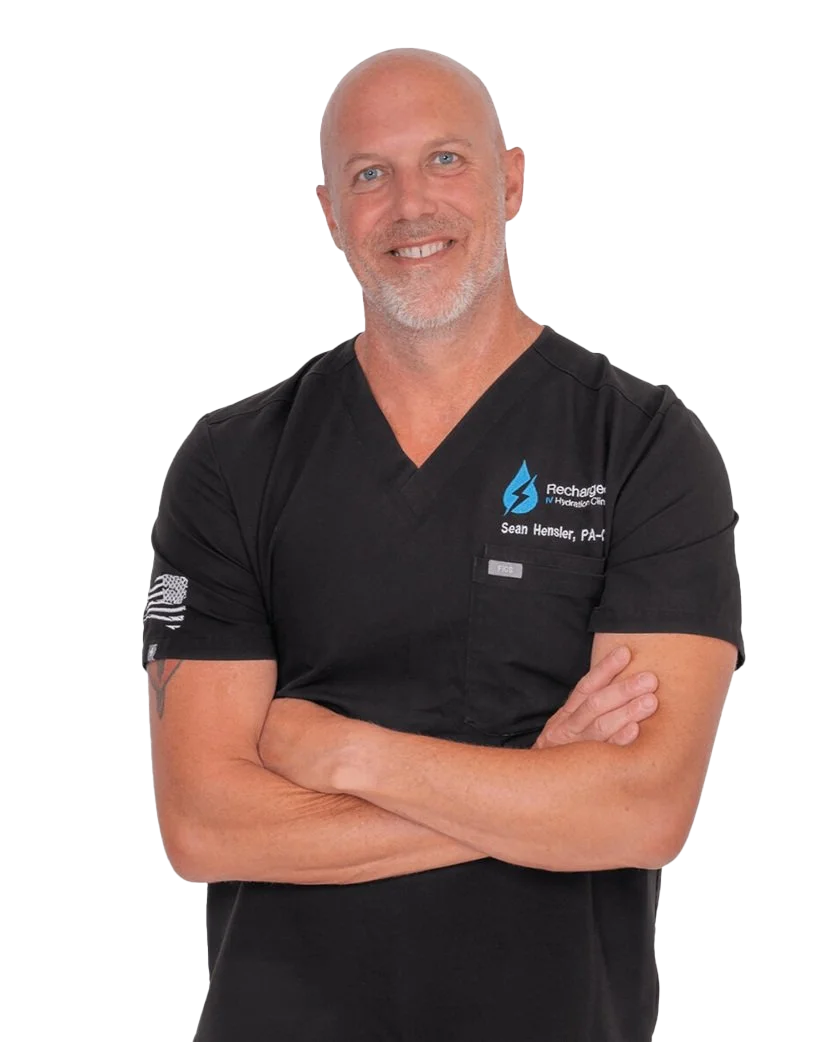 Sean Hensler, PA-C, MMScFounder & Medical Director
From questions to a plan.
Learning is step one. If you want to explore peptides for yourself, here's how it works with our provider team.
- ConsultationA licensed provider reviews your goals, health history and medications.
- Labs if neededBaseline labs for some goals so we know where you're starting.
- Personal planYour provider decides what makes sense, if anything, and why.
- Pickup & trainingSupplies plus nurse training on preparation, injection technique and storage.
- Follow-upCheck-in at about four weeks to review how you're doing.
- AdjustPlans change as your goals and results change.
Build a peptide, one amino acid at a time.
There are 20 standard amino acids. String a few together and you get a peptide. Keep going past about 50 and scientists start calling it a protein. Drag the slider or tap a real peptide to see its actual sequence.
BPC-157 is 15 amino acids long, a fragment of a protective protein in stomach juice.
Why length matters: short peptides like KPV or GHK can be tiny enough to work on skin. Longer ones like GLP-1 fold into shapes that fit very specific receptors. Past about 50 amino acids, chains fold into complex 3D proteins like growth hormone, which is 191 amino acids long.
Myth or fact?
Eight statements you'll see online. Call it, then see the answer.
Your body already makes thousands of peptides.
What did you learn?
Six questions. Get your peptide IQ.
Peptide questions, answered.
What are peptides?
Peptides are short chains of amino acids, usually between 2 and 50, that act as signaling molecules in the body. They bind to receptors on cells and tell those cells to do something specific, like release a hormone, repair tissue or calm inflammation. Your body makes thousands of them, including insulin, oxytocin and GLP-1.
What does peptide therapy do?
Peptide therapy uses specific natural or synthetic peptides to send targeted signals in the body. Depending on the peptide, researchers study effects on recovery, growth hormone release, metabolism, sleep, skin, immune function and libido. The evidence ranges from approved medicines to early animal research, so results depend heavily on which peptide is used.
Are peptides the same as steroids?
No. Steroids are built from a cholesterol ring structure and act on steroid receptors inside cells. Peptides are chains of amino acids that mostly act on receptors on the cell surface. Some peptides do influence hormones, such as growth hormone, but they work through different pathways.
What is BPC-157 used for?
BPC-157 is most often discussed for recovery from tendon, ligament, muscle and gut injuries. Those uses come mainly from animal studies, which report faster healing and new blood vessel growth. Human research is limited to a few small reports.
What's the difference between BPC-157 and TB-500?
BPC-157 is a 15-amino-acid fragment from a stomach protein and is studied for local tissue and gut repair. TB-500 is a 7-amino-acid fragment of thymosin beta-4 and is studied for cell movement and wound healing. They are often combined in the so-called Wolverine stack because they are thought to work through different repair pathways.
What is the Wolverine peptide stack?
Wolverine is a nickname for BPC-157 combined with TB-500, named after the comic-book character known for fast healing. The combination is popular for recovery, but it has been studied even less than either peptide on its own.
How long do peptides take to work?
It depends on the peptide and the goal. People often notice sleep or recovery changes within a few weeks, while body-composition changes usually take several weeks to months. Approved medicines like GLP-1s have well-defined timelines from clinical trials. Many others do not.
How are peptides taken?
Most peptides are injected just under the skin with a small insulin-style needle, because digestion breaks peptides down. Some are available as nasal sprays, creams or specially formulated oral forms.
What are the side effects of peptides?
Commonly reported side effects include redness or itching at the injection site, flushing, nausea, headache, water retention and changes in appetite or blood sugar. Side effects vary by peptide, and long-term safety data are limited for many of them.
Can women use peptides?
Many peptides are used by both men and women, and some, such as bremelanotide, were approved specifically for women. Peptides are not used during pregnancy or breastfeeding.
Do peptides help with weight loss?
The strongest weight-loss evidence belongs to GLP-1 medicines such as semaglutide and tirzepatide, which produced about 15–20% average weight loss in large trials. Other peptides discussed for fat loss, such as AOD-9604 or MOTS-c, have far less human evidence.
Where can I learn about peptide therapy in Wilmington, NC?
Recharged IV Functional Wellness in Wilmington, NC offers provider-led consultations to talk through peptides, your goals and your health history. Call (910) 441-3900 to schedule.
Curious what peptides could do for you?
Talk to a provider who will give you the honest version, including when peptides aren't the answer.
(910) 441-3900Sources & further reading
- BPC-157: literature and patent review (Pharmaceuticals, 2025)
- PubMed: BPC-157 research
- PubMed: thymosin beta-4 and tissue repair
- PubMed: CJC-1295 growth hormone studies
- PubMed: ipamorelin
- PubMed: sermorelin in adults
- PubMed: tesamorelin and visceral fat
- PubMed: MOTS-c
- PubMed: AOD-9604
- PubMed: semaglutide STEP trials
- PubMed: tirzepatide SURMOUNT trials
- PubMed: GHK-Cu and skin
- PubMed: bremelanotide (PT-141)
- PubMed: thymosin alpha 1
- Elamipretide (Forzinity) approval for Barth syndrome
- PubMed: KPV peptide and inflammation
Educational notice. This guide is for general education only and is not medical advice. It doesn't replace a visit with a licensed provider. Talk to a qualified clinician before starting, stopping or changing any treatment.
Many peptides described here are investigational or are prepared by compounding pharmacies, and most have not been evaluated by the FDA for the uses discussed. Availability depends on provider evaluation, pharmacy sourcing and current federal and state regulations, which change over time. Approved medicines named in this guide are approved only for their labeled conditions. Results vary from person to person and no outcome is guaranteed. Peptide therapy is not for use during pregnancy or breastfeeding or in anyone under 18. Several peptides are prohibited in competitive sport.